Medical disclaimer: This article is for informational purposes only, does not constitute medical advice, and has not been reviewed by a licensed medical professional. Results vary by individual. Always consult a qualified healthcare provider before making any healthcare decisions.
Quick answer: A dental bridge closes the gap left by one or more missing teeth, anchored by crowns on the teeth to either side. Most patients see the finished, natural-looking result within 2–3 weeks of the first appointment. Before-and-after photos consistently show a closed gap, matched tooth shade, restored bite, and — most reported by patients — a smile they're willing to show again.
What is a dental bridge?
A dental bridge is a fixed prosthetic that replaces one or more missing teeth. It's built from one or more artificial teeth, called pontics, fused to dental crowns that get cemented onto the natural teeth on either side of the gap — the abutment teeth. Unlike a partial denture, a bridge doesn't come out. Patients brush and floss around it like natural teeth, not soak it in a cup.
This guide draws on clinical before-and-after case data and thousands of smile transformation previews generated on the Makeover platform.
What real before-and-after dental bridge results look like
Ask patients what surprised them most after treatment, and the answer is rarely "the bite feels normal again." It's "you genuinely cannot tell which tooth is fake."
Before treatment, a missing tooth does more than leave a gap. It skews the whole smile — the space collapses inward slightly, the opposing tooth starts to over-erupt, and patients catch themselves smiling with their mouth closed. After a well-placed bridge, none of that shows. A properly shaded pontic sits flush with the gum line and matches its neighbors in color, translucency, and shape closely enough that even the patient's own dentist has to check the chart to confirm which tooth is prosthetic.
What changes, concretely:
Aesthetic changes
- The gap closes completely — no visible dark space when the patient smiles
- Neighboring teeth stop drifting, so the rest of the arch stays in its original position
- Shade matching means the pontic doesn't stand out under normal or flash lighting
- A well-designed pontic follows the existing gum contour instead of sitting on top of it
Functional changes
- Bite force redistributes evenly across the arch again
- Speech clarity improves noticeably when the missing tooth was in the front
- The drift and over-eruption that follow tooth loss stop
- Chewing on the treated side returns to normal within days of the final cementation
The clinical literature backs up what the photos show. A five-year retrospective study in the International Journal of Prosthodontics found that more than 90% of patients were satisfied with fixed partial dentures on both functional and aesthetic measures — and aesthetic satisfaction tracked closely with how natural the bridge looked, not just how well it chewed.
How does a dental bridge procedure work?
A dental bridge takes two appointments spread across two to three weeks — sometimes one, if the practice has same-day milling.
Appointment 1: prep and impression
- The abutment teeth on either side of the gap are reshaped to make room for the crowns
- Impressions or a digital scan capture the exact shape of the prepared teeth and the gap
- Shade matching happens at this visit, while the patient's natural tooth color is easiest to reference
- A temporary bridge is fitted to protect the prepared teeth while the permanent one is made
Between appointments: the lab build A dental laboratory fabricates the permanent bridge to the scan and shade specs. Traditional labs take 2–3 weeks. Same-day CEREC systems mill the bridge chairside in a single visit, skipping the temporary altogether.
Appointment 2: fit and cement
- The temporary bridge comes out
- The permanent bridge is tried in and checked against bite, fit, and how it reads next to the natural teeth
- Adjustments are made on the spot if anything is off
- The bridge is permanently cemented
Most patients report minimal discomfort once the permanent bridge is seated. Mild sensitivity around the abutment teeth for a few days afterward is normal and settles on its own.
Types of dental bridges and their results
The type of bridge changes both how it looks and how long it lasts — worth understanding before the consultation, not during it.
| Bridge type | Best for | Appearance | Avg. lifespan |
|---|---|---|---|
| Traditional bridge | 1–2 missing teeth with strong adjacent teeth | Excellent | 10–15 years |
| Cantilever bridge | Missing tooth with only one adjacent tooth | Good | 8–12 years |
| Maryland bridge | Front teeth, minimal preparation preferred | Very good | 5–10 years |
| Implant-supported bridge | Multiple missing teeth, strongest option | Excellent | 15–25+ years |
Traditional bridges are the default choice for a single missing tooth, and the before-and-after results are the most predictable of the four — both abutment teeth carry the load, so the fit and shade match hold steady for years.
Implant-supported bridges produce the most natural long-term look because they replace the root, not just the crown. That's the difference that prevents the jawbone loss under the gap that gradually changes facial shape over time — the reason a denture-wearer's face can look different ten years in.
Deciding between a bridge and a dental implant usually comes down to how much bone support remains and how much the patient wants to invest up front. A traditional dentist consult, paired with a photo-based preview of both outcomes, resolves that question faster than describing it out loud.
How long does a dental bridge last?
A traditional dental bridge lasts 10–15 years with proper care. According to the American Dental Association, bridges can run well past that range with consistent oral hygiene and regular checkups — the material doesn't fail on a timer, the gum and bone underneath it do.
What actually determines lifespan:
- Daily flossing under the bridge with a floss threader or water flosser — this is the single biggest factor
- Avoiding hard objects that stress the crowns (ice, pens, hard candy)
- Six-monthly professional cleanings, so plaque doesn't build up where a toothbrush can't reach
- The strength of the abutment teeth at the time of placement
The most common reason bridges fail early isn't the porcelain — it's decay developing underneath the crowns, in the area that's hardest to clean without a threader or water flosser. Patients who skip that step are the ones back in the chair at year six, not year twelve.
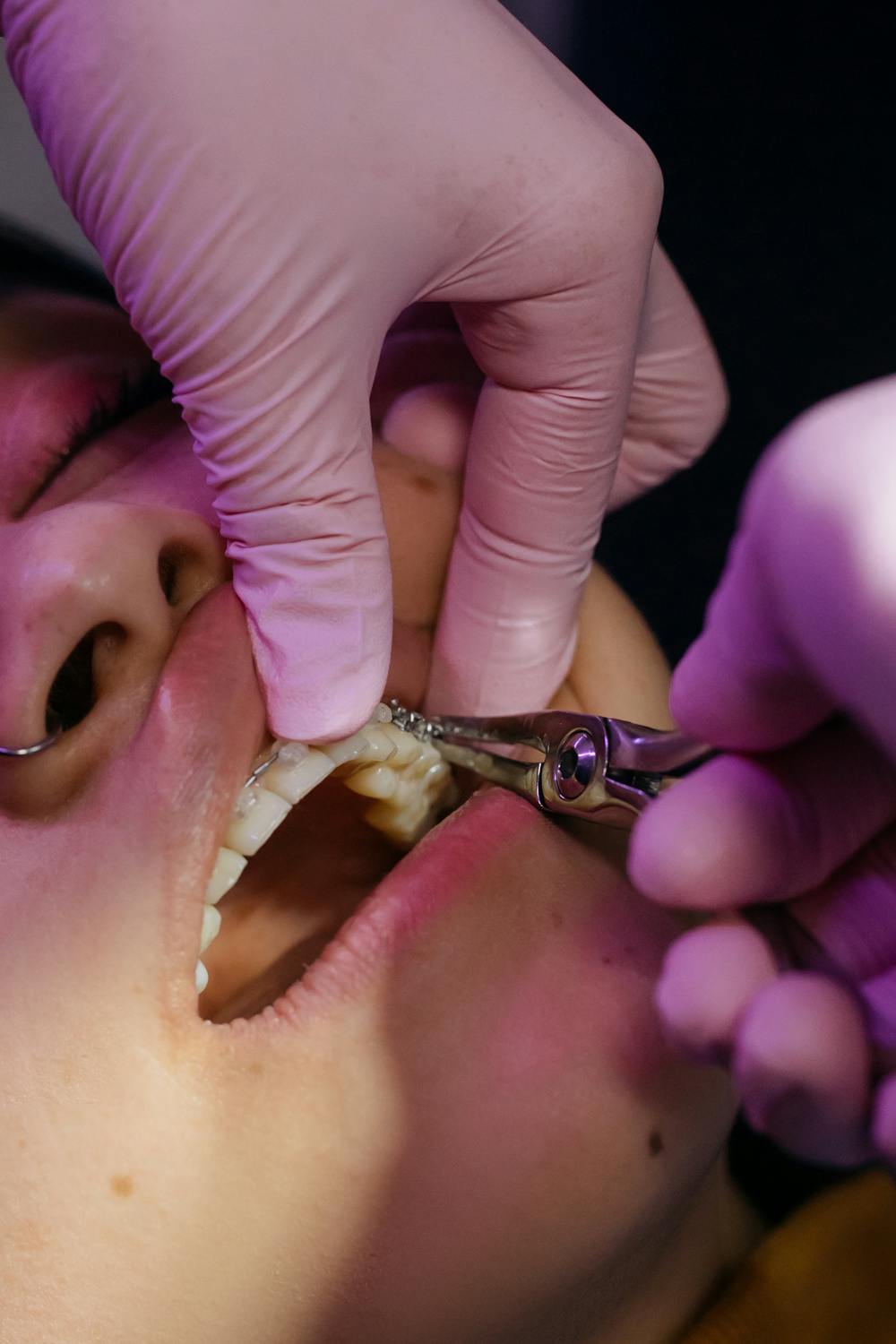
Shade matching at the prep appointment is what separates a bridge that disappears from one that doesn't. Photo: Pexels (free to use)
Can you preview your dental bridge result before treatment?
Yes, and it changes how the consultation conversation goes.
For years, the options were a verbal description or a stock photo of a stranger's smile. Neither gives a patient a real sense of how a bridge will sit against their own gap, their own gum line, their own tooth shade. That gap between "described" and "seen" is exactly where cases stall — a patient nods along in the chair, then calls to cancel two days later because they couldn't picture the result clearly enough to commit.
AI-powered preview tools close that gap. With a platform like Makeover, a dentist or treatment coordinator uploads the patient's consultation photo, selects the bridge treatment, and gets a photorealistic side-by-side preview in under 10 seconds — built on the patient's actual teeth, gum line, and facial proportions, not a stock model's.
Patients who see their own personalized before-and-after are more likely to move forward, because the decision stops being abstract. It's not "what might my smile look like" — it's a picture of their own face with the gap closed.
The Makeover Smile Readiness Scorecard
A five-point framework for evaluating whether a patient is ready to commit to bridge treatment at the consultation:
| Factor | What to assess | Why it matters |
|---|---|---|
| 1. Visual understanding | Can the patient picture their result? | Patients who can't visualize the outcome default to "let me think about it" |
| 2. Gap duration | How long has the tooth been missing? | Longer gaps mean more bone loss and a more complex case |
| 3. Abutment health | Are the adjacent teeth strong enough for crowns? | Determines whether a bridge is even viable, and for how long |
| 4. Bite alignment | Is the bite even across the arch? | A bridge placed into a misaligned bite wears out faster |
| 5. Hygiene habits | Does the patient floss consistently? | Predicts whether the bridge will hit its expected lifespan |
Practices that run this scorecard during the consultation — with a live preview on screen while they talk through each factor — report fewer "let me think about it" walk-outs. Patients leave with a clear picture of their own result, not a mental sketch they have to reconstruct at home.
For dental practices: turning consultations into accepted cases
The single biggest lever for bridge case acceptance isn't a better sales pitch — it's closing the gap between what the patient imagines and what they'll actually look like. A crown and bridge preview tool built for chairside use lets a treatment coordinator generate that picture in the same appointment, from a phone photo, with no scanner and no lab round-trip.
Every Makeover build is bespoke to the practice: shade libraries, gum contour modeling, and data handling are all scoped to how that specific practice works and what compliance it needs to meet — patient photos are never used to train AI models, and retention is the practice's call. There's no published price list, because every engagement is scoped to the practice's case volume and workflow on a consultation call.
Talk to Makeover about a bridge preview tool for your practice →