Quick answer: The bathroom renovations delivering the best results in 2026 combine spa-inspired tile work, updated fixtures, freestanding tubs, and frameless showers with smart storage that keeps a small footprint feeling open. Budget refreshes start under $2,000. Full remodels average $10,000 to $15,000. The renovations that go wrong almost always trace back to one thing: the homeowner committed to a tile, color, or layout they'd only seen in a showroom or a Pinterest board — not in their own bathroom.
Why Bathroom Renovations Return So Much Value
Bathrooms are among the highest-return rooms in the house to renovate. Remodeling Magazine's Cost vs. Value report puts the resale return on a mid-range bathroom remodel at around 67%. A homeowner who spends $15,000 on a solid, well-executed remodel typically recovers roughly $10,000 of it at sale, on top of the years of daily use they get from a better bathroom in the meantime.
That return has kept bathrooms near the top of the renovation priority list even as overall home-improvement spending has cooled. U.S. homeowners spent over $472 billion on home renovations in 2022, and bathrooms consistently place among the top two or three categories, alongside kitchens.
What's shifted going into 2026 isn't the budget — it's the brief. Homeowners are asking for spa-like comfort (heated floors, steam, freestanding tubs) instead of pure resale polish, and they're leaning on natural materials — stone, wood-look tile, warm metal — over the stark white-and-chrome look that dominated the last decade.
The thing that actually stalls most projects isn't money. It's uncertainty. A homeowner can approve a $12,000 line-item budget in a spreadsheet and still freeze the moment they're asked to pick a tile from a 4x4 sample chip, because a sample chip tells you nothing about how that tile will read across an entire wall in their light, next to their fixtures. That gap between "I approved a budget" and "I can picture the result" is where projects get delayed, downsized, or scrapped — and it's the problem visualization tools exist to close.
Bathroom Renovation Ideas by Budget
The right renovation depends less on square footage than on what's already failing. A bathroom with good bones — solid tile, working plumbing, decent layout — needs a cosmetic pass. A bathroom with a leaking pan, rotted subfloor, or a layout that fights the room needs a gut. Here's what real money buys at each tier.
Budget Updates Under $2,000
Repaint the walls and ceiling. A moisture-resistant semi-gloss in a warm white or soft sage is the fastest way to make a dated bathroom feel current. Budget $200–$500 for materials and a weekend of labor. Don't skip a proper bathroom-rated paint — standard interior paint blisters in a humid room within a year or two.
Replace the vanity light. Builder-grade strip lighting is one of the most visible signs of an untouched bathroom. A brushed nickel or matte black fixture runs $80–$300, installs in under an hour, and does more to change the room's feel than almost any other single swap.
Match the hardware. A faucet, towel bars, toilet paper holder, and cabinet pulls in the same finish reads as intentional design rather than a room assembled piecemeal over twenty years. Budget $300–$800. No plumbing rework required, just a wrench and an afternoon.
Regrout the tile. Grout darkens, cracks, and stains with age even when the tile underneath is fine. Stripping old grout and applying fresh grout costs $200–$600 depending on square footage and can make a 20-year-old floor look reinstalled.
Hang a new mirror. An oversized, backlit, or frameless vanity mirror changes the proportion of the room and bounces more light around it. Plan on $100–$400 for a piece with real presence.
Mid-Range Renovations: $5,000 to $15,000
Replace the vanity and sink. A new vanity with real storage — not just a cabinet with a hole cut for plumbing — changes how the room functions daily. Supply and installation typically runs $1,000–$4,000 depending on size and countertop material.
Redo the shower or tub surround. Swapping a dated fiberglass surround for large-format porcelain tile is the single biggest visual upgrade available at this budget. Pair it with a frameless glass door instead of a curtain or framed enclosure, and the shower stops reading as an enclosed box.
Upgrade the flooring. Heated tile or luxury vinyl plank adds both comfort and a materially different feel underfoot. Expect $1,500–$4,000 for materials and installation, with heated floors landing at the top of that range.
Convert a tub to a walk-in shower. This is one of the most requested renovations for homeowners over 40. In many markets it's now resale-neutral or positive: buyers increasingly expect at least one walk-in shower in the house, even if they still want a tub somewhere.
Upgrade the exhaust fan. A quiet, humidity-sensing exhaust fan is unglamorous, but it's the difference between a bathroom that stays mold-free and one that needs regrouting again in three years. Installed cost: $200–$500.
High-End Transformations: $20,000 and Up
Freestanding soaking tub. A sculptural tub becomes the visual anchor of a master bathroom on its own. The tub itself runs $2,000–$10,000 before plumbing, with the final number driven heavily by material: cast iron and stone-resin composites cost more than acrylic but hold heat and finish quality noticeably better.
Steam shower. A fully tiled shower with a built-in steam generator turns a daily routine into a home-spa moment. Budget $5,000–$12,000 installed, and plan for a properly sealed enclosure. Steam showers that aren't detailed correctly at the seams develop moisture problems fast.
Radiant floor heating. Electric or hydronic in-floor heat is best added during a full renovation, since the flooring is already coming up. It's a comfort upgrade more than a resale driver, but it's consistently the feature homeowners say they'd never renovate without a second time.
Custom built-in storage. Millwork built to the room's exact dimensions eliminates the wasted corners and awkward gaps that stock cabinetry leaves behind. It costs more than off-the-shelf storage, but it's the difference between a bathroom that looks custom and one that looks assembled from a catalog.
Smart bathroom technology. Digital shower controls, lit smart mirrors, and voice-activated lighting add $2,000–$8,000 to a project. They're a smaller share of renovations than the trend coverage suggests, but they're becoming standard in the true luxury tier.
Small Bathroom Renovation Ideas
A small bathroom doesn't need a bigger budget — it needs different priorities than a large one.
Light colors do more work than square footage. Light walls, light tile, and a light ceiling push the perceived boundary of the room outward. Save dark, saturated colors for bathrooms over roughly 50 square feet, where they read as intentional rather than cramped.
Large-format tile shrinks visual noise. It sounds backward, but fewer grout lines make a small floor look larger, not smaller — the eye reads continuous surface instead of a grid of interruptions.
A floating vanity opens the floor. Wall-mounted vanities expose the floor beneath them, which makes the room feel bigger and makes it easier to clean, since there's no cabinet base collecting hair and dust.
Swapping a tub for a full-width shower changes the whole layout. In a tight bathroom, a tub often eats the one dimension the room can't spare. Removing it for a full-width shower is frequently the single change that makes a small bathroom function like a larger one.
A pocket or sliding door reclaims real floor space. A swing door needs roughly nine square feet of clearance it can never use for anything else. In a small bathroom, that's space you can't afford to give up.
Master Bathroom Renovation Ideas
The master bath is where homeowners are most willing to spend on comfort rather than resale math. The trends holding through 2026:
Double vanities. Two sinks with separate storage is the single most-requested feature in master bath renovations, and for good reason: it eliminates the daily friction of sharing one sink and one mirror.
Shower niches instead of shelving. Built-in niches keep bottles organized without the visual clutter of a wire caddy hanging off the shower arm, and they read as a planned detail rather than an afterthought.
Separating wet and dry zones. A partial wall or a panel of frosted glass between the shower/tub area and the vanity/toilet area creates a hotel-suite feel and lets two people use the room at once without being in each other's way.
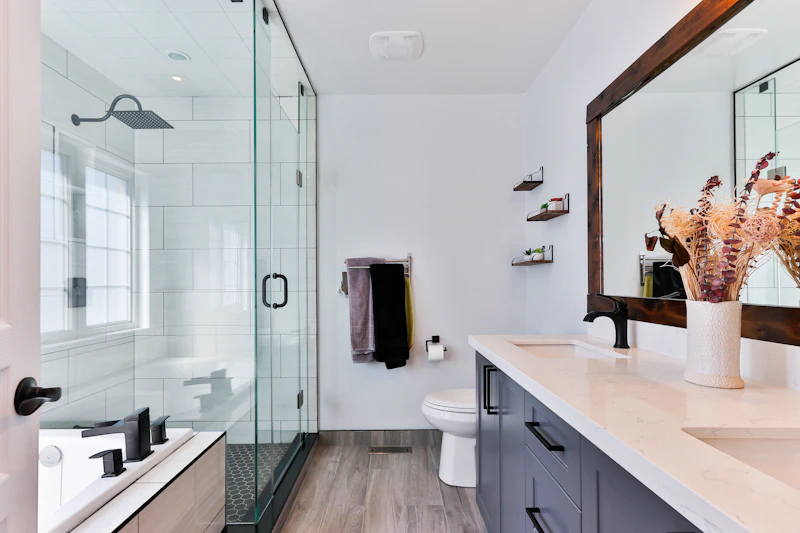
Natural materials over stark white. Stone slabs, warm wood tones, and natural-fiber textiles are replacing the all-white, all-chrome look that defined master baths a decade ago — a shift toward warmth over sterility.
Renovation Mistakes That Waste Money
Most bathroom renovation regret has less to do with taste and more to do with information — homeowners approve decisions with less certainty than they realize.
Choosing tile from a small sample. A 4x4 chip under showroom halogen lighting looks nothing like the same tile across an entire shower wall in your bathroom's actual light. Bold patterns and dark grout are the most common casualties — striking in a sample, overwhelming at full scale.
Skipping the permit on a "simple" plumbing move. Relocating a toilet or shower drain even a few feet can require a permit depending on jurisdiction. Unpermitted plumbing work can complicate a home sale later and, in some cases, isn't covered by insurance if something goes wrong.
Underestimating lead times. Custom vanities, specialty tile, and freestanding tubs can carry 6–12 week lead times. Contractors who don't flag this upfront end up with a torn-out bathroom sitting unusable while materials are in transit.
Over-customizing a small bathroom. A bold, highly personal design in the only full bathroom in a starter home can hurt resale more than it helps daily enjoyment. That trade-off is worth making consciously, not by accident.
Approving a layout change without seeing it in context. A contractor's sketch or a generic inspiration photo doesn't show you how a new layout interacts with your window, your door swing, or your actual ceiling height. This is the mistake visualization tools solve directly — and it's the reason we built ours.
See Your Bathroom Before You Renovate It
Every mistake above traces back to the same root cause: approving a decision based on a description instead of a picture of your own space. That used to require a 3D rendering firm and a five-figure design fee. It doesn't anymore.
Custom AI visualization software — the kind Makeover builds for renovation and design businesses — can generate a photorealistic bathroom preview from a single uploaded photo in under 30 seconds. Here's what that looks like in a real consultation:
- The client uploads a clear photo of their current bathroom.
- They choose a direction — modern, traditional, spa, farmhouse, or a custom brief.
- They get a photorealistic before-and-after render almost instantly.
- They share it with their contractor or designer to lock in the vision before ordering materials.
For designers and remodeling contractors, this replaces the slow back-and-forth of swatches and sketches with a single image that either lands or doesn't — and when it lands, clients stop hesitating and start approving. For homeowners, it's the clearest answer available to "what will this actually look like in my bathroom?" before a single tile is ordered.
For more on how designers use this for full-room projects, see our guide on virtual room makeovers for interior designers. If you run a renovation or design business and want this built into your own consultations, talk to our team about what that would look like for your clients.