Medical disclaimer: This article is for informational purposes only, does not constitute medical advice, and has not been reviewed by a licensed medical professional. Results vary by individual. Always consult a qualified healthcare provider before making any healthcare decisions.
Quick answer: PRP under eye treatment uses your own blood plasma to improve skin thickness and tone beneath the eye. Clinical studies show clear improvement in colour uniformity. Most patients need three sessions and see real results six to eight weeks after starting. It works best for dark circles caused by thin skin, not deep hollows or pure genetics.
What is PRP under eye before and after? It describes the visible change to the under-eye area after a series of platelet-rich plasma (PRP) injections. A small sample of your own blood is spun in a centrifuge to concentrate the platelets, which are then injected into the tear trough and the skin around the eye. The growth factors in those platelets build new collagen, thicken the skin, and improve local blood flow. Over four to eight weeks, the under-eye area looks less shadowed and more even in tone — not more filled, just healthier.
That distinction matters more than anything else in this guide. PRP changes the quality of the skin. It does not add volume. Patients who confuse the two end up disappointed, no matter how well the injections were performed.
This guide draws on peer-reviewed PubMed clinical studies, PMC randomised controlled trial data, and published treatment protocols for periorbital PRP therapy.
What causes under-eye dark circles?
Dark circles are not one problem. They are four different problems that look similar, and the treatment that fixes one does almost nothing for another. The Mayo Clinic notes that lifestyle, genetics, and ageing all play a role. Treating them well starts with knowing which type you actually have — which is exactly what a consultation should establish before anyone talks about PRP.
Vascular dark circles look blue or purple. They form when blood pools in the tiny vessels under the eye. The skin here is the thinnest on the face. This makes the blood vessels visible through it. These circles are worse when you are tired and improve with sleep.
Pigmentation dark circles look brown. They come from too much dark pigment in the under-eye skin. Sun exposure, hormones, and genetics all contribute.
Structural dark circles look like shadows. They form when volume is lost in the tear trough area. The hollow creates a shadow, no matter what your skin tone is.
Combination dark circles are the most common type. They involve two or more of the causes above at the same time.
PRP targets vascular and pigmentation dark circles. It thickens the skin and improves blood flow, which is exactly what those two causes need. It has little effect on structural dark circles caused by volume loss — filler works better for those, because a shadow from a hollow needs volume back, not better skin.
How does PRP work for dark circles?
PRP works by using growth factors from your own concentrated platelets to rebuild collagen and circulation in skin too thin to hide the vessels beneath it. The process starts with a standard blood draw of about 10 to 20 mL from your arm. The blood goes into a centrifuge, which spins the sample and separates the plasma from concentrated platelets. Those platelets carry growth factors including PDGF, TGF, VEGF, and EGF — the same signaling proteins your body already uses to heal wounds and build tissue.
The concentrated PRP is then injected into the skin of the tear trough and under-eye area, roughly 1 to 1.5 mL per side. The growth factors kick off several processes at once. New collagen grows, thickening the skin and making the blood vessels beneath it less visible. New blood vessels form, improving local circulation and reducing the pooling that causes vascular dark circles. Some studies also report a mild brightening effect on pigmentation-type circles.
None of this happens overnight. The skin needs four to eight weeks to respond to the growth factors, so judging results after one session — or one week — will only leave you unimpressed with a treatment that hasn't finished working yet.
What do PRP under eye before and after results look like?
A completed PRP under-eye series typically shows less darkness, more even skin tone, and softer fine lines — a gradual change rather than a dramatic one. Before treatment, the under-eye area usually shows some mix of darkness, thin skin, fine lines, and dull colour. After a full series, most patients describe their skin as looking more alive and more even in tone, with fine lines softening as the skin thickens with new collagen.
Set the right expectations before you book the first session. PRP does not add volume the way filler does. It will not fix a deep tear trough hollow, and it will not fully clear dark circles that come from genetics rather than skin quality. Patients who expect one round of PRP to erase every cause of a dark circle end up disappointed — not because the treatment failed, but because it was asked to do a job it was never built for.
What it does well is improve skin quality in the most delicate, hardest-to-treat area of the face, with results that typically last six to twelve months and a side-effect profile that stays low because the injectate is your own blood. Published trials on periorbital PRP consistently report measurable improvement in colour uniformity and pigmentation after a full session series, even though the individual studies are small — modest evidence on paper, but notable given how minor and low-risk the treatment is compared to surgery or a laser series. The specific numbers are worth a closer look, covered next.
What does the clinical evidence say?
The published research on PRP for dark circles is small in sample size but consistent in direction, and it points to one practical conclusion: a single session tells you little about what PRP can do, and the trials that used a full series show meaningfully better results than the one that didn't.
A PubMed study by Mehryan et al. followed 10 patients after a single 1.5 mL PRP injection into the tear trough. At three months, colour uniformity had improved significantly (P = 0.010), but melanin content, wrinkle depth, and skin hydration barely moved. One injection wasn't enough to shift the metrics that matter most for texture and pigment — a finding that on its own argues against judging PRP by a single treatment.
A split-face trial tested a full protocol instead of a single shot: 23 patients received four weekly PRP sessions on one side of the face and carboxytherapy on the other. At the three-month follow-up, the PRP side showed a 46.6% reduction in melanin area compared to 14.3% on the carboxytherapy side (P = 0.002) — a meaningfully larger effect than the single-injection study above, and direct evidence that PRP outperforms at least one other non-surgical alternative.
A separate trial in PMC tested PRP as an add-on to nanofat grafting rather than as a standalone treatment. Patients who received nanofat plus PRP reported full satisfaction at the three-month mark, compared to two-thirds of patients who received nanofat alone, with mild residual darkness across the entire combination-treatment group versus under half of the nanofat-only group. It's a different protocol than a PRP-only series, but it points the same direction — pairing PRP with a complementary treatment tends to outperform either approach used alone.
Put together, the evidence supports PRP as a legitimate option for thin-skin and vascular dark circles, provided patients commit to a full session series rather than a single injection. Protocols vary — some practices run three sessions a month apart, the trial above used four weekly ones — but the pattern across the research holds: more sessions beat one, and any provider promising a transformation after a single treatment is setting expectations the data doesn't back.
The Makeover Under-Eye Treatment Selector
Bring this table to your consultation and match your dark circle type to the right treatment before your provider even opens their kit — it will make the conversation shorter and the plan more accurate.
| Dark circle type | Root cause | Best treatment | PRP role |
|---|---|---|---|
| Blue/purple darkness | Thin skin, poor circulation | PRP + optional laser | Primary — thickens skin, improves blood flow |
| Brown pigmentation | Melanin, sun damage | PRP + topical brighteners | Supporting — mild pigment reduction |
| Hollow shadows | Volume loss | Tear trough filler | Limited — PRP does not replace lost volume |
| Fine lines + thin skin | Collagen loss | PRP + resurfacing laser | Strong — collagen growth improves skin quality |
| Combination type | Mixed causes | PRP + filler combined | Partial — PRP handles skin, filler handles hollows |
This framework draws on Makeover.so's review of under-eye treatment outcome data and clinical consensus on dark circle types.
PRP under eye recovery timeline
Recovery from PRP under-eye treatment is measured in days, not weeks — the results themselves just take longer to show up than the swelling takes to go down.
| Timeline | What to expect |
|---|---|
| Day 1 | Mild swelling and possible bruising at injection sites. Redness fades within hours. |
| Day 2 to 3 | Swelling peaks. Bruising may show. Cold compresses help. |
| Day 4 to 7 | Swelling clears for most patients. Bruising fades. The area looks normal. |
| Week 4 to 8 | Early improvements in tone and texture appear as collagen builds. |
| After session 3 | Full results show — usually three to four months after starting. |
Swelling and short-lived bruising are the most common side effects, and nearly every patient sees some version of them. Major reactions are rare, and because PRP uses your own blood, there's no risk of allergy or foreign-body rejection — the safety trade-off that makes PRP appealing even to patients who are cautious about injectables in general.
Two prep habits make the difference between a quiet recovery and a bruised week: skip blood-thinning medications, alcohol, and supplements like fish oil for three to five days before each session, and hold off on retinol or other active skincare in the under-eye area for five days after each injection.
PRP vs. filler for under eyes: which is better?
Neither is universally better — PRP wins for thin skin and discoloration, filler wins for hollow tear troughs, and the right choice comes down to which of those two problems you actually have.
| Factor | PRP | Tear trough filler |
|---|---|---|
| Best for | Thin skin, discoloration, fine lines | Hollow tear troughs, shadow effects |
| Results timing | Gradual (4 to 8 weeks per session) | Immediate |
| Results duration | 6 to 12 months | 12 to 18 months |
| Risk profile | Very low (your own blood) | Low to moderate |
| Sessions needed | 3 sessions typically | 1 session typically |
| Cost per treatment | Lower per session | Higher single-session cost |
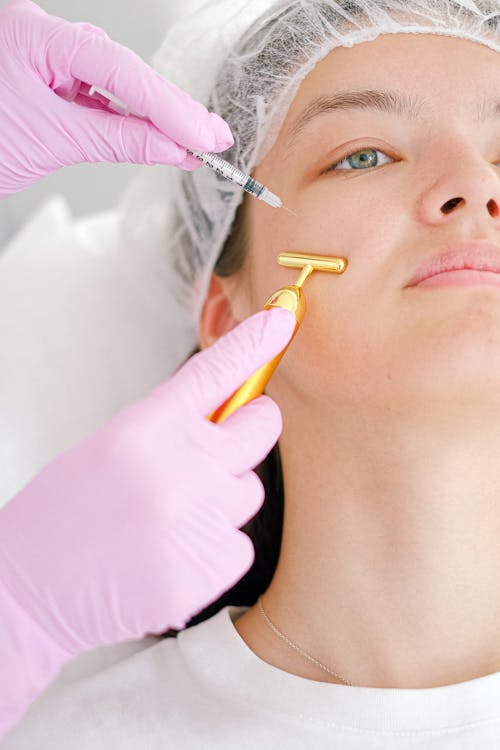
Image: Free photo by Anna Shvets via Pexels
For patients with deep tear trough hollows and a shadow effect, tear trough filler delivers results that PRP alone cannot match — the volume is restored the moment the needle comes out, with no waiting on collagen to build.
For patients with dark circles from thin skin and poor blood flow, PRP is the better long-term choice. It improves the skin itself instead of masking a problem that isn't really about volume.
Many injectors use both together for patients with mixed causes — filler to fill the hollow, PRP to fix the skin sitting over it. You can also explore under eye filler before and after results to see what the filler approach looks like on its own.
How to preview your under-eye transformation
The under-eye area is one of the most impactful places to treat, and one of the most nerve-wracking to commit to. Patients want to know if the result will look natural on their own face and whether the cost is worth it — reasonable questions that are hard to answer from someone else's before-and-after photos.
Makeover builds AI preview software for med spas and injector practices. Where a practice offers a Makeover-built tool, a photo can show what a brighter, fresher under-eye area could look like on your own face — useful for setting realistic goals before your first PRP session and for showing your provider exactly the outcome you're aiming for. Photos processed by a Makeover-built tool are handled under the practice's own retention policy, built to meet HIPAA and other regulations relevant to them, and are never used to train AI models.
Ask your provider whether they offer this. If you run a med spa or injectables practice and want a custom-built preview tool for your patients, share your details with the Makeover team.