Medical disclaimer: This article is for informational purposes only, does not constitute medical advice, and has not been reviewed by a licensed medical professional. Results vary by individual. Always consult a qualified healthcare provider before making any healthcare decisions.
Quick answer: Botox forehead before and after results show smoother horizontal forehead lines and a more relaxed resting expression following frontalis muscle treatment. Most patients need 10 to 30 units. Results appear within 3 to 5 days, reach their peak at day 14, and last 3 to 4 months. The key risk to understand is brow drooping from over-treatment.
What is botox forehead before and after? It is the visual change in the forehead area following botulinum toxin injections into the frontalis muscle. Before treatment, horizontal lines form when you raise your brows — in more advanced cases, they stay visible even at rest. After treatment, the forehead sits smoother, lines soften or disappear during movement, and the resting expression looks less tense.
This guide draws on Allergan clinical trial data, published botox dosing guidelines, and practitioner guidance on forehead treatment technique and unit ranges.
Why forehead botox is the most requested treatment area
The forehead is where most patients start. Horizontal lines form with every brow raise, and over time these dynamic lines can turn static — visible even when the face is relaxed. The frontalis muscle spans the entire forehead, drives brow elevation on its own, and responds predictably to botulinum toxin, which is part of why injectors treat it first and treat it often.
According to the American Society of Plastic Surgeons 2024 Statistics Report, neuromodulator treatments increased by 4% year over year, with nearly 10 million treatments performed in the United States in 2024. The forehead and glabella remain the most commonly treated areas in clinical practice.
Forehead botox is frequently combined with glabellar (frown line) treatment in a single session. The two muscle groups are anatomically linked, and treating one without the other can affect brow position and expression balance.
What does botox forehead before and after look like?
The result of well-executed forehead botox is a smoother, less expressive forehead with a rested, open appearance. It should not look frozen or expressionless.
Before treatment:
- Horizontal lines form clearly when raising brows
- In patients with deep or established lines, grooves may be visible at rest
- The forehead may show a "corrugated" appearance in certain lighting
- Active brow-raising creates prominent creases
After treatment:
- Lines soften or disappear during brow elevation
- At rest, the forehead appears smooth
- The skin sits flat without the tension lines of muscle contraction
- Some movement is preserved with a natural-looking treatment
What natural results look like: You can still raise your brows slightly. The movement is dampened, not eliminated. Lines form faintly or not at all during expression. Your face reads as rested and youthful rather than treated.
What over-treated results look like: The forehead is completely flat and immobile. Brows cannot be raised. The brow tail may drop. The face loses natural expression. This is the complaint injectors hear most often from patients who were over-dosed by an inexperienced provider elsewhere.
Results by unit count and line depth
The number of units used directly affects how much muscle relaxation occurs and how smooth the result is.
| Units Used | Muscle Effect | Expected Result | Best For |
|---|---|---|---|
| 10 to 14 units | Partial relaxation | Lines soften, movement preserved | First-time patients, conservative result seekers |
| 15 to 20 units | Significant relaxation | Lines largely disappear, some movement retained | Most patients, standard clinical dosing |
| 21 to 30 units | Full relaxation | Lines essentially eliminated, minimal movement | Patients with strong muscles, deep static lines |
Allergan's clinical guidelines suggest a starting dose of 20 units (4 units across 5 injection sites) for horizontal forehead lines when combined with glabellar treatment. This provides a reliable reference point, though practitioners customise based on individual anatomy.
Gender differences: Men typically require 25 to 40% more units than women for equivalent results. The male frontalis muscle is generally thicker and more active. A standard female dose will often produce only mild relaxation in a male patient.
First-time vs returning patients: First-time patients often receive a conservative dose to assess their muscle response. A review appointment at two weeks allows the injector to add units if needed, rather than starting too high and causing over-treatment.
The Makeover Forehead Botox Assessment Framework
Four factors determine the right unit count and how your result will look. A thorough injector walks through all four at your consultation — if yours skips this, ask.
| Assessment Factor | What to Evaluate | Why It Matters |
|---|---|---|
| Line Depth | Are lines dynamic (only during expression) or static (visible at rest)? | Static lines require more units and may not fully resolve with a single treatment |
| Muscle Strength | How pronounced is brow elevation? Can you raise one brow independently? | Stronger muscle activity requires higher unit counts |
| Brow Position | Is the brow naturally low-set or at a good height? | Low brows require careful dosing to avoid ptosis (brow drooping) |
| Prior Treatment | Have you had forehead botox before, and how did you respond? | Previous response guides dosing and injection pattern |
Based on clinical injection mapping guidelines and practitioner education resources for forehead botox technique.
Botox forehead: injection sites and technique
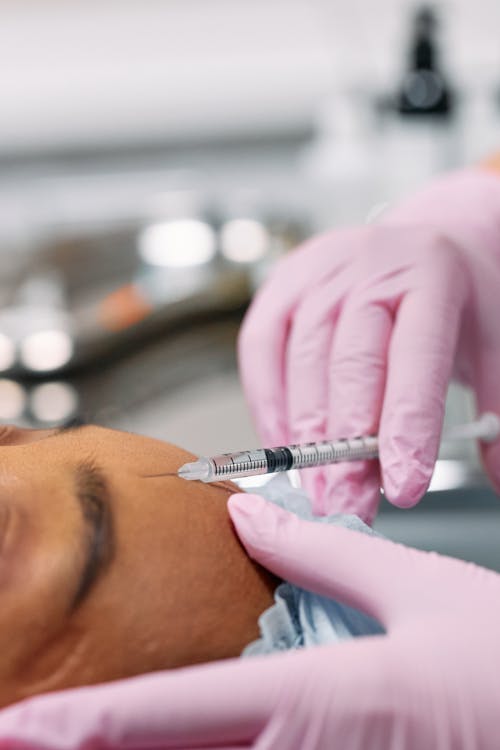
The frontalis muscle is injected across a grid of points spanning the forehead. The standard approach uses 5 injection sites, but experienced injectors customise the pattern based on individual muscle anatomy.
Key technique principles:
Lower forehead restriction: Injecting too low on the forehead (within 2 to 3 cm of the brow) increases the risk of brow drooping. Most injectors maintain a safety margin and treat the upper and mid forehead only.
Combined glabellar treatment: Forehead-only botox often causes the brow to drop because it relaxes the frontalis without addressing the depressor muscles that pull the brow down. Treating the glabella (frown lines) at the same time balances the pull and preserves brow position.
Lateral distribution: Injecting too far toward the temples can affect the lateral brow arch. Experienced injectors shape the injection pattern to enhance or preserve the desired brow shape.
What can go wrong: brow drooping and over-treatment
Forehead botox has a high safety profile when performed correctly. The main risks are technique-related rather than inherent to the product.
Brow drooping (brow ptosis): The most common complication. Occurs when the frontalis muscle is over-relaxed or when injection points are placed too low. The brow sinks below its natural position, creating a heavy, tired appearance. It is temporary and resolves as the botox wears off, but can persist for 6 to 10 weeks. Eye drops that stimulate a specific eye muscle can provide mild temporary correction.
Frozen appearance: Too many units or injection placement that eliminates all muscle movement. The forehead appears completely flat and expressionless. Natural-looking results always preserve some movement.
Asymmetry: Uneven results from inconsistent depth or unit distribution. Minor asymmetry often corrects itself as the botox settles. Significant asymmetry can be addressed with a top-up of units to the weaker side at the two-week review.
Headache: Some patients report a mild headache in the 24 hours after forehead botox. This is temporary and typically resolves without medication.
Long-term safety: Botox has been used in clinical and aesthetic medicine for over three decades. The FDA's current prescribing information reflects decades of safety data. Long-term regular treatment does not cause permanent damage to the frontalis muscle. However, some patients who receive botox for many years report that lines do not return as deeply between treatments, as the repeatedly relaxed muscle gradually loses mass. This is generally considered a desirable outcome by most patients.
How long do forehead botox results last?
Forehead botox results typically last 3 to 4 months before the frontalis muscle gradually regains its movement and lines return.
Onset is rapid compared to most aesthetic treatments:
- Days 3 to 5: First signs of muscle relaxation appear. Lines begin to soften.
- Day 14: Full effect visible. This is the correct time to assess results and determine whether a top-up is needed.
- Months 1 to 3: Results at their best. Forehead appears smooth with preserved natural expression.
- Months 3 to 4: Lines gradually return as the botox metabolises and muscle activity resumes.
Factors that affect how long forehead botox lasts:
- Metabolism: Higher metabolic rate (common in very active patients) may shorten duration.
- Muscle strength: Stronger muscles may reassert themselves more quickly.
- Number of prior treatments: Regular treatment over time gradually weakens the frontalis muscle, extending the interval between sessions for many patients.
- Dose used: Higher doses generally produce longer-lasting results, up to a point.
Botox forehead cost guide
Forehead botox pricing varies by clinic, injector credentials, and geographic location.
| Treatment | Typical US Price |
|---|---|
| Forehead only (10 to 20 units) | $200 to $400 |
| Forehead + glabella (combined) | $400 to $600 |
| Per unit pricing (where applicable) | $12 to $20 per unit |
| Touch-up session (at two weeks) | $50 to $150 for additional units |
Most clinics offer forehead and glabella treatment as a combined package because the two areas are anatomically linked. Treating only one of these areas risks affecting brow position.
Avoid clinics that price forehead botox at extremely low price points. Botox cost is directly tied to product authenticity, injector training, and appropriate unit quantities. Under-dosing to cut costs produces results that last 6 to 8 weeks rather than 3 to 4 months.
How to preview your forehead botox results before treatment
The most common source of dissatisfaction with forehead botox isn't the injection — it's a mismatch between what the patient pictured and what the injector delivered. Some patients want near-complete smoothing. Others want to keep some movement. Those two goals need different unit counts and different injection patterns, and a five-minute consultation conversation doesn't always surface which one you actually want.
Ask your injector whether they offer an AI preview during your consultation. Clinics running Makeover-built software generate a photorealistic before-and-after preview on your actual face — upload a photo, select the forehead as the treatment area, and see your projected result in under 10 seconds.
The preview helps you:
- See the difference between a conservative dose and a complete one before you commit to either
- Decide how much brow movement you want to keep
- Show your injector exactly the result you're after, instead of describing it
- Walk into treatment day with expectations that already match the plan
If you run a med spa or clinic and want a preview tool like this built for your own consultation room, get in touch with Makeover to see what a bespoke build looks like for your practice.