Medical disclaimer: This article is for informational purposes only, does not constitute medical advice, and has not been reviewed by a licensed medical professional. Results vary by individual. Always consult a qualified healthcare provider before making any healthcare decisions.
Quick answer: Dentures restore your smile and the ability to chew and speak comfortably. Full dentures replace an entire arch and rest on the gums. Partial dentures clip onto remaining natural teeth to fill gaps. Snap-on dentures anchor to two or more implants for a hold that doesn't slip. Full sets run $1,500 to $3,600 in 2026; snap-on dentures cost $5,000 to $12,000 per arch, implants included.
What does a denture before and after actually show? The "before" is usually gaps, a collapsed bite, or a mouth with no teeth at all — often paired with a sunken lower face and a self-conscious smile. The "after" is a full arch that restores chewing, speech, and facial support. How dramatic that change looks depends almost entirely on which type of denture you get and how well it's made — a $1,500 economy set and a $10,000 implant-retained set can produce very different "afters" from the same starting point.
This guide uses 2026 pricing from CareCredit, denture-wear statistics from the American College of Prosthodontists, and bone-loss research published in peer-reviewed dental journals.
How many people wear dentures in 2026?
Tooth loss is far more common than most people assume. About 40 million Americans wear some form of denture, according to the American College of Prosthodontists — and the rate climbs sharply with age: 57% of Americans between 65 and 74 wear dentures. Gum disease and untreated decay drive most of that number, not age on its own.
The US denture market is valued at more than $2 billion, and it's growing on two fronts at once: more people losing teeth, and more of those people refusing to settle for a denture that looks obviously fake. That second shift is the real story of 2026 — the gap between a bargain-bin denture and a well-made one, or between a removable set and an implant-retained one, has never been wider. Which side of that gap you land on depends on the choices below.
What does a denture before and after look like by type?
The starting point looks similar across all three denture types: missing teeth, a shifted bite, or a collapsed lower face. What changes is the "after," and it changes a lot depending on which denture you choose.
Full denture
- Before: No teeth remain in the arch. The lips fold inward, the lower face looks shortened, and chewing or speaking clearly is difficult.
- After: A complete arch of replacement teeth restores lip support and facial height. The smile looks full again, though the denture rests on the gums and relies on suction and adhesive to stay put.
Partial denture
- Before: One or more gaps where natural teeth are missing, with neighboring teeth often already drifting into the empty space.
- After: The gaps are filled with teeth matched to your natural shade and shape. Small metal or resin clasps anchor it to remaining teeth — visible up close, but easy to miss in normal conversation. Drifting stops.
Snap-on (implant-retained) denture
- Before: Same starting point as a full denture — no remaining teeth in the arch.
- After: A full arch that clips onto two or more implants and doesn't shift when you eat, laugh, or talk. Because it sits closer to the gumline than a conventional denture, it reads more like fixed teeth, and the implants themselves stop the jaw bone from continuing to shrink.
Full, partial, and snap-on dentures compared
| Feature | Full (Conventional) | Partial | Snap-On (Implant-Retained) |
|---|---|---|---|
| Teeth replaced | All in one arch | Selected missing teeth | All in one arch |
| Retention | Suction and denture adhesive | Clasps on natural teeth | Implant anchors |
| Stability | Moderate (may slip) | Good | Excellent |
| Bone preservation | No (bone resorbs) | Partial | Yes (implants preserve bone) |
| Removable | Yes | Yes | Yes (clips on/off) |
| Natural appearance | Good (depends on quality) | Good | Excellent |
| Adjustments needed | Yes, as bone changes shape | Less frequent | Minimal |
| Cost (US, 2026) | $1,520 to $3,648 | $1,333 to $4,203 | $5,000 to $12,000 per arch |
| Lifespan | 5 to 10 years | 5 to 10 years | 10 to 20+ years |
What happens to your face when you lose teeth?
Losing teeth changes more than your smile — it changes your bite, and eventually your bone. The jaw bone needs the pressure of chewing to maintain its density; once teeth are gone and that pressure stops, the bone begins to resorb. The American Academy of Periodontology notes that a significant share of that bone loss happens within the first year after extraction alone.
The visible effects build gradually:
- The lower third of the face shortens
- Lips fold inward and look pursed at rest
- Cheeks lose fullness and look hollow
- The chin appears more pointed, closer to the nose
- Speech gets harder to understand as lip and tongue support changes
Left untreated for a decade, this can add years to how old someone looks — not from aging itself, but from the structural loss underneath the skin. A well-fitted denture reverses most of the visible change by restoring jaw height and supporting the lips and cheeks from the inside. Snap-on implant dentures go further: because the implants integrate with the bone, they stop the resorption process rather than just masking it.
Curious how this compares to fixed options? See our guides to dental implant before and after and dental bridge before and after.
The Makeover Denture Type Decision Framework
Walk into your first consultation with this filled out, and the conversation moves a lot faster.
| Factor | Full Conventional Denture | Partial Denture | Snap-On Implant Denture |
|---|---|---|---|
| Remaining natural teeth in the arch | None | Some remain | None |
| Budget available | $1,500 to $3,600 | $1,300 to $4,200 | $5,000 to $12,000 per arch |
| Bone density | May be reduced | Not a primary concern | Needs to be sufficient |
| Stability priority | Moderate | High — clasps on natural teeth | Very high |
| Open to implant surgery | No | N/A | Yes |
| Bone preservation priority | Low | N/A | High |
| Cost preference | Lower upfront | Moderate | Higher upfront, lower long-term |
If you check more boxes in the right-hand column than you expected, that's usually a sign implants are worth pricing out even if you walked in assuming a conventional denture. Ask your dentist for an AI preview of the result during the consult — it turns the conversation into something you can both look at, not just describe.
How long do dentures last?
Full and partial dentures last 5 to 10 years on average, and bone loss is almost always the reason they wear out — not the material itself. As the jaw reshapes underneath the denture, the fit that felt secure at delivery gradually loosens.
Relining resets that fit without replacing the whole set: a dentist adds new material to the underside of the denture to match your current gum shape. Most dentists recommend relining every 2 to 3 years, alongside the yearly check-ups the American Dental Association recommends for tracking fit and gum health.
Will dentures stay in without adhesive? Upper dentures form a suction seal against the roof of the mouth and usually hold on their own. Lower dentures are the harder case — there's less surface area for suction, and the tongue constantly breaks the seal during speech and eating. Needing a thin layer of adhesive for a lower denture is normal, not a sign of a bad fit. Snap-on dentures skip the problem entirely; the implant anchors hold the arch in place without any adhesive at all.
Watch for these signs it's time to reline or replace:
- The denture shifts noticeably when eating or talking
- The same sore spot keeps recurring
- Your bite feels different than it used to
- You're using more adhesive than you were six months ago
Snap-on dentures last considerably longer — 10 to 20 years for the prosthetic teeth themselves, and the titanium implants anchoring them can last a lifetime with routine care.
How much do dentures cost in 2026?
CareCredit's 2026 denture cost guide shows a wide range based on type and quality:
| Denture Type | Average Cost (US, 2026) | Full Range |
|---|---|---|
| Full conventional (economy) | $1,968 per arch | $1,520 to $3,648 |
| Partial resin | $1,738 | $1,333 to $3,283 |
| Partial metal framework | $2,229 | $1,728 to $4,203 |
| Snap-on implant-retained | $2,480 per arch (prosthetic only) | $5,000 to $12,000 per arch including implants |
| Premium custom | $6,514 | $5,000 to $12,438 |
Insurance: Most dental plans cover roughly half the cost of basic dentures after your deductible, up to an annual maximum. Snap-on dentures blend prosthetic and surgical costs, and implant placement itself is often billed — and covered, if at all — separately from the denture. Confirm both pieces with your plan; the National Association of Dental Plans has a plain-language breakdown of what dental benefits typically include.
Payment options: Most practices offer financing through CareCredit or LendingClub Patient Solutions, which spreads a premium or implant-retained denture into monthly payments instead of one lump sum.
Dentures vs dental implants: which is right for you?
This is the question that decides everything else — budget, timeline, and how much surgery you're willing to have.
| Factor | Conventional Dentures | Dental Implants |
|---|---|---|
| Surgery required | No | Yes (implant placement) |
| Cost (full arch) | $1,500 to $3,600 | $3,000 to $5,000 per tooth; $20,000+ for full arch (All-on-4) |
| Stability | Moderate | Excellent (fixed) |
| Bone preservation | No | Yes |
| Maintenance | Daily removal and cleaning | Same as natural teeth |
| Lifespan | 5 to 10 years | Lifetime (implant fixture) |
| Best for | Patients preferring no surgery or with limited bone density | Patients wanting fixed, permanent-feeling teeth |
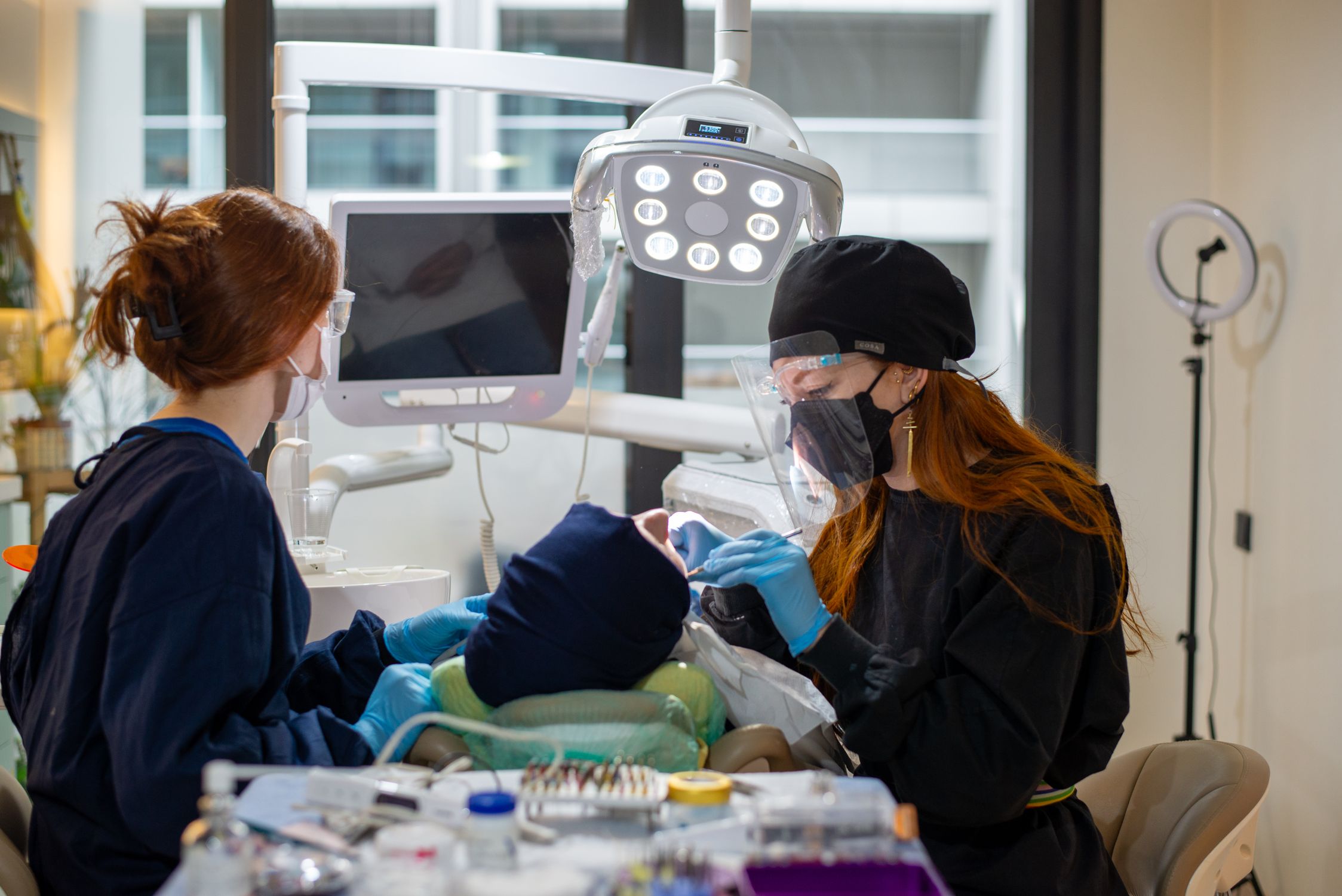
For patients with enough jaw bone to support them, implants tend to win on the numbers that matter long-term — stability, bone preservation, total years of service. For patients who can't have surgery, or would rather not, a well-made denture, especially a snap-on set, closes most of that gap without it. The American Academy of Implant Dentistry publishes plain-language guides on what makes someone a good implant candidate.
For a full cost breakdown, see our guide to dental implant before and after, or check dental crown before and after if you're only dealing with a single tooth.
How to preview your denture result before treatment
Denture results live or die on details a price list can't capture — tooth shade, tooth shape, how much the arch supports your lips, how wide the smile reads. Two patients getting the "same" full denture can walk out with noticeably different faces.
Some dental practices now close that gap with custom AI preview software, like the tools Makeover builds for clinics. The practice takes a photo of your current smile, and the software generates a photorealistic preview of your restored smile on your own face in under 10 seconds, before any impressions are taken.
That preview does two jobs at once. You get to see the actual outcome instead of imagining it from a shade chart. And your dentist gets a concrete visual target, which cuts out the back-and-forth guessing over tooth size and color once the lab work starts.
It also tends to move people off the fence. Plenty of patients put off replacing missing teeth for years, partly because it's hard to picture how much better a denture will look until it's already in their mouth. Seeing that change rendered on your own face beforehand is often what turns "maybe someday" into a booked appointment.
Ask your dental practice if they offer this before your next visit.
Ready to preview your denture result?
Ask your dental practice whether they offer an AI-generated preview of your denture results — most patients don't know to ask, and most practices are happy to show you if they have it. If your dentist doesn't offer this yet, practices interested in adding a custom AI preview tool for patients can reach out to Makeover to scope a build for their clinic.