Medical disclaimer: This article is for informational purposes only, does not constitute medical advice, and has not been reviewed by a licensed medical professional. Results vary by individual. Always consult a qualified healthcare provider before making any healthcare decisions.
Quick answer: Braces before and after results vary by treatment type and case severity, but the endpoint is the same — straighter teeth, a corrected bite, and a more balanced smile. Metal, ceramic, Invisalign, and lingual braces all reach that endpoint; the difference is how visible, comfortable, and fast the process is, not how good the final result looks. Most patients finish in 18 to 24 months, with the biggest visible change happening in cases involving severe crowding, overbite, or crossbite.
What is a "braces before and after"? It is the documented change in tooth alignment, bite, and smile shape from the start of orthodontic treatment to the finish — the shift from crooked, crowded, or gapped teeth to a straight, functional bite. Results build in stages, not all at once: most patients notice the first visible change around month three and the full transformation between month 18 and month 24.
This guide draws on data from the American Association of Orthodontists (AAO) 2024 patient census, published PMC orthodontic research, Cleveland Clinic clinical guidance, and treatment outcome data across traditional and clear aligner systems.
How popular are braces in 2026?
Braces are more common right now than at any point on record. The American Association of Orthodontists 2025 patient census (reporting 2024 data) counted 6.66 million patients in active treatment across US and Canadian AAO-member practices — the highest total ever reported.
Adults are the fastest-growing segment. According to the AAO, roughly 1.91 million adults are now in active orthodontic treatment in the US, up from 1.64 million in 2022. One in three orthodontic patients today is an adult.
Clear aligner technology is most of the reason why. Invisalign and similar systems removed the main thing that kept adults out of a consultation for decades: the fear of spending two years with a mouth full of visible metal.
What do braces before and after look like?
Orthodontic treatment produces one of the clearest before-and-after changes in dentistry, because it's one of the few treatments that reshapes an entire arch rather than a single tooth. Crooked, crowded, or gapped teeth end up straight and evenly spaced. Bite problems that affected chewing — and in some cases how the lower face looked — get corrected along the way.
The smile change also brings other benefits:
- Easier oral hygiene (straight teeth are easier to clean, lowering decay risk long term)
- Better bite function and less jaw strain
- A more balanced smile within the face
- In severe bite cases, a slight shift in how the lips and lower face sit at rest
The change is biggest for patients with:
- Severe crowding or rotation
- Large gaps between teeth
- Significant overbite, underbite, or crossbite
- Multiple concerns at once
For patients with mild misalignment, the change is smaller but still real. Straighter teeth improve both how the smile looks and long-term dental health.
During treatment: Braces cause soreness for 2 to 4 days after fitting and after each adjustment. This is normal — it means teeth are moving. Most patients get used to their appliance within the first few weeks.
Braces before and after by treatment type
All four systems below straighten teeth and correct bite problems to comparable final results when matched to the right case. What changes between them is visibility during treatment, comfort, cost, and how long it takes to get there — not the quality of the outcome.
Traditional metal braces
Metal braces are the most widely used orthodontic system and the one with the longest clinical track record. Stainless steel brackets bond to the front of each tooth, and an archwire threaded through them applies steady, continuous force to move teeth into position.
Before: Crooked, crowded, or gapped teeth, with or without a bite problem. After: Straight, aligned teeth and a corrected bite. Metal braces handle every level of complexity, from mild spacing to severe bite correction, adding appliances like expanders or elastics when a case needs the extra force.
They are the most visible option during treatment and, in most markets, the most affordable — the trade-off is less discretion for more versatility on hard cases.
Ceramic (clear) braces
Ceramic braces work exactly like metal braces mechanically. The only difference is the bracket material: tooth-colored or clear ceramic instead of stainless steel, so the hardware blends into the smile instead of standing out against it.
Before: Same as metal braces. After: Same result as metal braces — this is a cosmetic choice during treatment, not a different outcome at the end.
The trade-off is upkeep: ceramic brackets stain from coffee, tea, and dark foods faster than metal does. Many orthodontists compromise by using ceramic on the upper front teeth, where it's most visible, and metal on the back teeth, where strength matters more than looks.
Invisalign and clear aligners
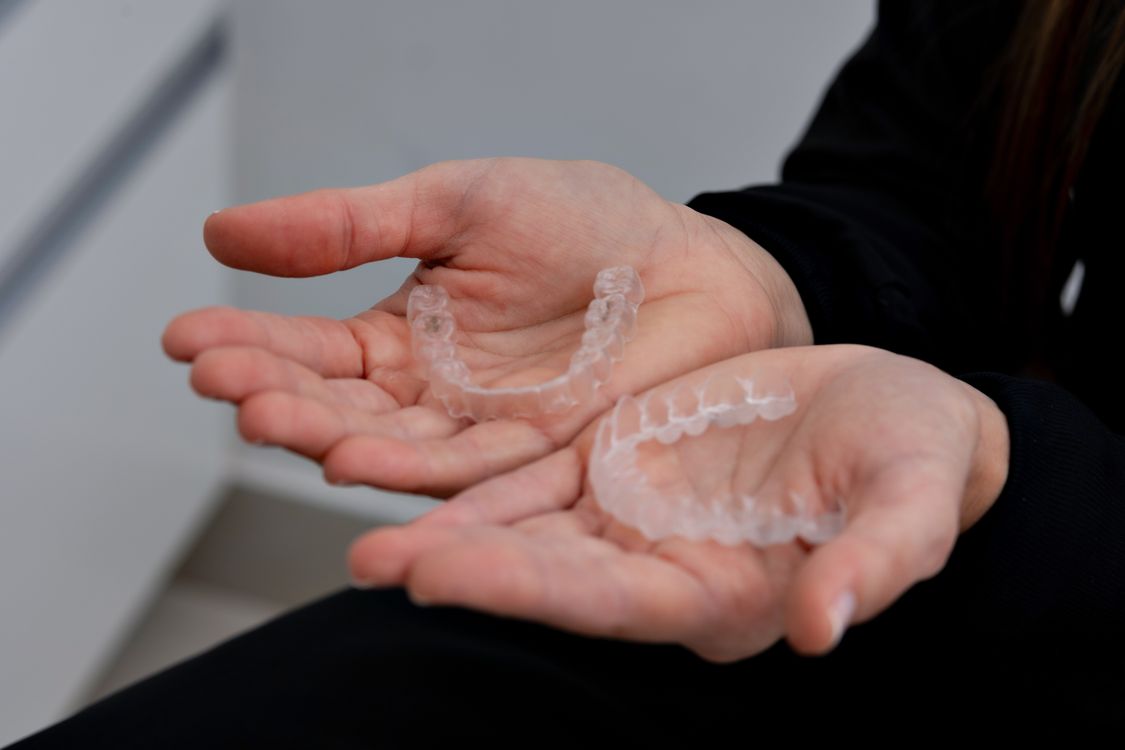
Invisalign moves teeth through a series of custom clear plastic trays, each one nudging teeth slightly closer to their final position. Patients swap trays every 1 to 2 weeks, and the entire sequence is mapped digitally before the first tray is ever made.
Before: Crooked or gapped teeth, mild to moderate crowding, mild bite issues. After: Results comparable to traditional braces for eligible patients. According to Cleveland Clinic, clear aligners handle most routine cases well when worn 20 to 22 hours a day.
That "20 to 22 hours" figure is the catch — aligners only work while they're in the mouth, so results depend on patient discipline in a way fixed braces don't. Invisalign is also less suited to severe bite problems or complex tooth rotations. When it's the right fit, treatment runs 12 to 18 months on average, shorter than the 18 to 24 months typical for traditional braces, and the trays can be removed to eat, brush, and floss normally.
Lingual braces
Lingual braces are mechanically the same as metal braces, mounted on the tongue side of the teeth instead of the front. Nothing shows when the patient smiles.
Before: Any level of misalignment, including complex cases. After: The same result quality as metal braces, with zero visible hardware and the ability to treat cases that Invisalign can't reach.
Three trade-offs come with that: higher cost, a rougher first few weeks as the tongue adjusts to the brackets, and a shorter list of orthodontists trained to place them — lingual technique requires specific training that not every practice offers.
Braces before and after by concern
Treatment type is one variable; the dental concern being corrected is the other, and it usually has a bigger effect on how dramatic the before-and-after looks. Crowding and gaps produce the most visually obvious change. Bite corrections — overbite, underbite, crossbite — produce a subtler smile change but a bigger functional one.
Crowding
Crowding happens when teeth overlap or rotate because there is not enough space in the arch. It is the most common reason patients start orthodontic treatment.
Before: Overlapping, rotated, or uneven teeth. May include teeth that have not come in fully. After: All teeth sit in proper alignment. The change is large and easy to see in photos. In severe cases, some premolars may be removed to create space.
Gaps and spacing
Gaps between teeth can appear anywhere in the arch. The most common is a gap between the two upper front teeth.
Before: Visible space between teeth. After: Teeth close together to fill the gap. A retainer is usually needed long term to stop the gap from opening again.
Overbite
An overbite is when the upper front teeth cover the lower front teeth too much. A slight overbite is normal. A deep overbite causes tooth wear and bite problems.
Before: Upper teeth cover lower teeth when biting. After: The bite is corrected so upper and lower teeth meet properly. Elastics or extra appliances help speed up the correction. Facial balance improves and jaw stress drops.
Underbite
An underbite is when the lower teeth sit in front of the upper teeth. It often has a bone component. Braces can fix mild underbite. Severe cases may need jaw surgery combined with orthodontics.
Before: Lower jaw sticks out. Lower teeth sit in front of upper teeth. After: Mild cases show a better bite and improved face profile. Severe bone cases need surgery plus orthodontics for full correction.
Crossbite
A crossbite is when some upper teeth bite inside the lower teeth. It can affect the front or back teeth and may cause the jaw to shift to one side.
Before: Upper and lower arches do not line up when biting. After: The crossbite is fixed, jaw shift is gone, and bite function improves. In younger patients, an expander may be used to widen the arch before braces start.
The Makeover Orthodontic Outcome Scorecard
Use this framework to match your concern and preference to the right treatment type and expected outcome.
| Concern | Best Treatment Option | Typical Duration | Visibility During Treatment | Result Quality |
|---|---|---|---|---|
| Mild crowding | Invisalign or ceramic braces | 12–18 months | Low to moderate | Excellent |
| Moderate crowding | Traditional or ceramic braces | 18–24 months | Moderate | Excellent |
| Severe crowding | Traditional metal braces | 24–36 months | High | Excellent |
| Gaps/spacing | Invisalign or traditional | 6–18 months | Low to high | Excellent |
| Overbite correction | Traditional with elastics | 18–30 months | High (metal) / Low (Invisalign) | Very good |
| Underbite (mild) | Traditional with elastics | 24–36 months | High | Good to very good |
| Crossbite | Traditional or ceramic | 18–30 months | Moderate to high | Excellent |
| Discreet appearance | Invisalign or lingual | 12–24 months | Very low | Excellent for eligible cases |
The Makeover Orthodontic Outcome Scorecard — developed to help patients and orthodontists match treatment type to specific concerns, expected results, and aesthetic preferences during treatment.
Treatment timeline: what to expect month by month
Most patients see the first visible tooth movement by month three, major alignment change by month twelve, and the full result — straight teeth, corrected bite, retainer fitted — between month 18 and month 24.
| Timeframe | What Happens |
|---|---|
| Month 0 (consultation) | X-rays, photos, impressions/scans. Treatment plan confirmed. |
| Month 1 (fitting) | Brackets bonded or first aligner tray fitted. Soreness for 2 to 4 days. Adaptation begins. |
| Months 2–6 | First visible tooth movement. Spacing and rotation corrections become visible. Adjustments every 4 to 8 weeks. |
| Months 6–12 | Major alignment improvements visible. Bite correction with elastics begins if needed. |
| Months 12–18 | Smile significantly transformed. Most patients see the result they hoped for. Fine adjustments begin. |
| Months 18–24 | Final detailing. Bite fully corrected. Brackets removed or final aligner worn. Retainers fitted. |
| Post-treatment | Retainers worn full-time for 6 to 12 months, then nightly long term. |
For complex cases, treatment runs 30 to 36 months. Traditional braces need adjustment every 4 to 8 weeks. Invisalign trays are swapped every 1 to 2 weeks. Missing appointments or wearing aligners fewer than 20 to 22 hours a day will extend treatment.
Do braces change your face shape?
Braces change your face shape only when they correct a bite problem — moving teeth alone, without a bite correction, does not alter how the face looks outside the smile.
Patients treated only for crowding or spacing see their teeth move. The jaw relationship stays the same, so the rest of the face is unaffected.
For patients with a big overbite, underbite, or crossbite, fixing the bite does change the face profile:
- Fixing a deep overbite brings the lower jaw slightly forward. This improves chin shape and the balance between the lips and chin.
- Fixing an underbite reduces how much the lower jaw sticks out.
- Fixing a crossbite can reduce jaw shift and facial unevenness.
These changes are positive and natural-looking. They are not as dramatic as facial surgery, but they can improve the balance of the face when seen from the side.
In children and teens, bite correction has a bigger effect on facial growth because the bones are still developing. This is why orthodontists often recommend treating bite problems early. It is easier to guide growth than to correct a fully grown jaw.
Adult braces: what to expect
Adults make up 1 in 3 orthodontic patients in the US and the number keeps rising. Adult treatment produces the same quality results as treatment in adolescence. There are some differences to be aware of:
- Treatment may take slightly longer — adult bone is denser and teeth move more slowly
- Retainers are more critical — adult teeth have a stronger pull back to their old positions
- Gum health matters more — gum disease must be treated before orthodontics starts, as moving teeth in unhealthy bone can cause damage
- Invisalign is very popular with adults — it is discreet in work and social settings
Adults also tend to comply better with treatment than teens — especially with Invisalign. They chose the treatment themselves rather than being told to do it.
Cost guide
Braces cost between $3,000 and $13,000 in the US, depending on the system: traditional metal is the most affordable, lingual braces the most expensive.
| Treatment Type | Typical Cost (USD) | Treatment Time |
|---|---|---|
| Traditional metal braces | $3,000–$7,000 | 18–24 months |
| Ceramic braces | $4,000–$8,000 | 18–24 months |
| Invisalign | $3,500–$8,500 | 12–18 months (typical) |
| Lingual braces | $8,000–$13,000 | 18–30 months |
| Retainers (post-treatment) | $150–$600 per set | Ongoing |
Most dental plans cover part of orthodontic treatment for patients under 18. Adults may get partial coverage or none. FSA and HSA accounts can be used for orthodontic costs. Most orthodontic practices offer payment plans.
Preview your straight teeth before treatment
The hardest part of committing to braces isn't the cost or the discomfort — it's that the result is 18 to 24 months away. Gallery photos on an orthodontist's website show someone else's teeth moving through someone else's treatment. They don't answer the question a prospective patient actually has: what will my smile look like?
That's the gap we build preview software to close. Ask your orthodontist whether they offer an AI preview during your consultation — with Makeover-built software, they upload your photo, apply a straight-teeth simulation, and show you a photorealistic result on your own face in under 10 seconds. Orthodontists using the tool report patients booking treatment with clearer expectations from that first visit, instead of guessing at an outcome they can't picture.
For related dental guides, see our dental bridge before and after and dental crown before and after articles.