Medical disclaimer: This article is for informational purposes only, does not constitute medical advice, and has not been reviewed by a licensed medical professional. Results vary by individual. Always consult a qualified healthcare provider before making any healthcare decisions.
Quick Answer: A tattoo cover-up works by placing a new, larger, and darker design over the existing tattoo to conceal it. The best cover-ups use bold fills, dark botanical designs, mandalas, or blackwork. Results depend on the size, darkness, and colour of the original ink. Faded or laser-lightened tattoos are easiest to cover. Dense black tattoos require a skilled artist and a strategic design.
What is a tattoo cover-up? A tattoo cover-up is a new tattoo applied directly over an existing one. The new design uses strategic placement, shading, and saturation to conceal the original. Done well, the old tattoo becomes invisible beneath the new artwork.
This guide breaks down the size, darkness, and placement rules professional cover-up artists use to hide old ink, which designs actually work, and how to walk into a consultation knowing what to ask for.
How common are tattoo cover-ups?
Tattoos are more common than ever. Approximately 35 to 40% of US adults have at least one tattoo in 2026, with rates reaching 55 to 60% among adults aged 18 to 35. As that large population of tattooed adults ages, the demand for cover-ups grows with it.
Cover-up tattoos now account for 20% of all tattoo sessions, making them one of the most requested services in professional studios. The overall tattoo regret rate sits at 17%, and many of those who feel regret turn to cover-ups rather than removal. Cover-ups are faster, cheaper, and can produce a result that is actually better than the original.
The US tattoo industry generates an estimated $4.2 to $4.8 billion annually in 2026, growing at 8 to 10% per year. Cover-up work is a growing segment of that revenue.
What makes a tattoo cover-up work?
A cover-up works when the new design is darker, larger, and more detailed than the original. The new ink sits on top of the old ink. It does not erase it. The key is building a design that absorbs the darkness of the existing tattoo into its own visual language.
Three factors determine whether a cover-up will succeed.
Size. As a general rule from professional artists, the new design needs to be at least two to three times larger than the original tattoo. This gives the artist the canvas space to build a design that hides the original without crowding.
Darkness. The cover-up design must be equal to or darker than the existing ink. You cannot cover black with light grey or pastel colours. The new ink will not be strong enough to obscure what is underneath.
Placement. An experienced cover-up artist positions the new design so that the darkest elements of the new work fall directly over the darkest parts of the old tattoo. A floral stem over a solid line. A mandala centre over a dense patch of black. Strategic placement does most of the heavy lifting.
What about the age of the tattoo?
Older tattoos are easier to cover up than fresh ones. Ink fades over time. A 10-year-old tattoo has softer edges and lighter saturation than one done last year. That natural fading gives the cover-up artist more flexibility with design and colour.
Design ideas that succeed as cover-ups
Not all designs are equal for cover-up work. The most effective cover-up designs share one feature: they use deliberate darkness as part of their aesthetic. These are not compromises. They are beautiful designs that happen to cover effectively.
Bold botanical and floral designs
Large floral designs with dense leaves, petals, and stems are among the most popular cover-up solutions. The layered shading in roses, peonies, and tropical leaves creates natural contrast that absorbs dark ink beneath it. Black and grey florals work on almost any original tattoo.
Mandalas and geometric blackwork
Mandala designs use symmetry and dense geometric fills to cover ground evenly. Every section of the mandala sits over a section of the old tattoo. Geometric blackwork, which uses solid black shapes and patterns, is one of the most effective styles for covering heavy, dark original work.
Animal portraits with dark backgrounds
A bold animal portrait — a panther, wolf, or owl — surrounded by a dark atmospheric background can cover a large area of old ink effectively. The background fill does the covering work. The portrait creates the focal point.
Sleeve expansions
If you have isolated tattoos that you want to merge or update, a sleeve design that unifies them can turn disconnected old work into a cohesive piece. The connecting background and shading between elements cover the gaps and the unwanted parts.
Japanese and neo-traditional styles
Both Japanese and neo-traditional tattooing use bold outlines, rich fills, and heavy saturation. These styles are built for cover-up work. The colour density in traditional tattooing is high enough to conceal most dark original ink.
What cover-up designs fail and why
Not every design works as a cover-up. Understanding what fails prevents an expensive mistake.
Light or pastel designs. Watercolour tattoos, fine-line minimalism, and pastel shading do not have enough ink density to cover dark original work. The old tattoo shows through. These styles only work over very faded or very small original tattoos.
Designs the same size as the original. A cover-up design that matches the size of the original leaves no room for error. The edges of the original tattoo will bleed out from under the new design. Size up every time.
Same-placement scripts or names. Trying to cover a name or text with another text tattoo in the same position almost never works. The new letters stack awkwardly on the old ones. The result looks heavy and unclear. Use a completely different design style and element type.
Relying on colour to cover black. Any colour placed over dense black ink will be altered by what is underneath. Purple becomes brown. Yellow disappears. Red turns muddy. Dark colours can tame this effect. Light colours cannot.
What to expect: tattoo cover up before and after
Before a cover-up, you have an unwanted tattoo you look at every day. It might be a name, a dated design, a faded mess, or something you never loved. After a successful cover-up, that tattoo no longer exists as a separate, visible element. Instead, you have a cohesive piece of artwork where the original cannot be distinguished.
What changes visually depends on the original and the approach:
Small original, fresh cover-up design: The transformation is dramatic. The original disappears inside the new design. The result reads as a single intentional piece with no visual trace of what came before.
Dark, saturated original with a bold cover-up: The result will be a larger, darker piece than you had before. That is unavoidable. The cover-up needs more density to hide the original. The upside is that well-executed dark work — a mandala, a blackwork sleeve, a bold floral — looks intentional and powerful.
Old faded tattoo with a new coloured piece: This produces the most flexibility. Faded ink is much easier to cover. The cover-up artist has more options for colour, size, and style. The before-and-after transformation here is often the most visually striking.
Cover-up cost expectations: A professional cover-up typically costs more than a fresh tattoo of the same size. The added complexity of working over existing ink requires more skill, more planning, and often more sessions. Most cover-up tattoos run between $200 and $500 for small to medium work, with complex or large cover-ups costing $800 or more depending on the artist.
Laser fading before a cover-up: is it worth it?
For dark, saturated, or large original tattoos, a few sessions of laser fading before a cover-up changes everything. You do not need full removal. Just enough fading to reduce the density of the original ink.
The North American tattoo removal market was valued at $166 million in 2023 and continues to grow. A significant portion of that demand comes from people prepping for cover-ups, not seeking complete removal.
After laser fading, the cover-up artist has more colour options, more design freedom, and more flexibility on size. The difference between covering a jet-black tattoo and a laser-faded grey one is dramatic.
Most artists recommend waiting 6 to 8 weeks after your final laser session before starting a cover-up. This lets the skin heal fully and lets the ink settle to its final post-laser shade.
If you want to understand the laser removal process before deciding on a combination approach, see our full guide to tattoo removal before and after results.
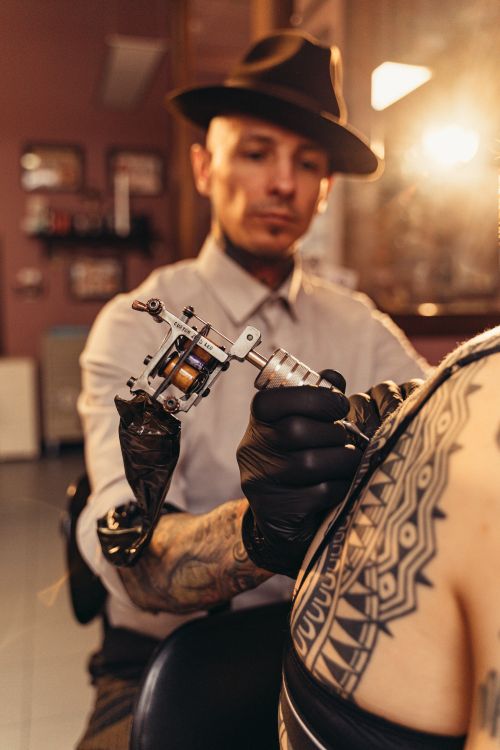
Image: Free photo by Antoni Shkraba Studio via Pexels
How to preview your cover-up before committing
A cover-up is permanent. The decision to commit to a design that will live on your body for life deserves more than a quick sketch on paper or a verbal description from your artist.
We build Makeover to solve this exact problem for tattoo studios. A studio using it can take a clear photo of the area you want covered, apply the design style or colour approach you are considering, and generate a photorealistic before-and-after preview in under 10 seconds.
The preview shows the new design sitting on your real skin, your real arm, your real body. Not on a stock photo. Not on paper. On you.
To be clear about what this does and doesn't replace: the preview shows design intent — placement, scale, and how the new artwork sits against your skin tone. The final linework, shading texture, and healed result still come down to your artist's hand and how your skin heals. What it removes is the biggest unknown going into a consultation: whether the design and size you're picturing actually work on your body at all.
Where a studio offers this, the preview lets you:
- Confirm the design size and placement before the appointment
- See how the new work interacts with surrounding tattoos
- Align with your artist on direction before they start drawing
- Avoid the single biggest cause of cover-up regret: choosing a design you haven't truly visualized on yourself
For clients considering both laser fading and a cover-up, a studio using Makeover can preview the cover-up result at the faded stage, so you can plan both phases before starting either. Ask your studio if this is something they offer.
The Makeover Cover-Up Readiness Framework
We built this checklist from the same questions cover-up artists ask in nearly every consultation. Run through it before you book so you and your artist start from the same page.
| Readiness Factor | What to Check | Why It Matters |
|---|---|---|
| Size assessment | Is the proposed design at least 2-3x larger than the original? | Undersized cover-ups fail at the edges |
| Darkness match | Is the new design darker than or equal to the original ink? | Light designs cannot cover dark ink |
| Style suitability | Does the chosen style use dense fills or deep shading? | Thin-line or watercolour styles lack the density to cover |
| Artist experience | Has the artist done cover-ups of similar complexity before? | Cover-ups require different skills than fresh tattoos |
| Laser prep decision | If the original is heavy, has laser fading been considered? | Fading opens up significantly more design options |
Work through this scorecard before your consultation. If your studio offers a Makeover-built preview, bring a printed or saved copy to the appointment. Artists who can see what you are envisioning produce better results.
The bottom line
Tattoo cover-ups work when the new design is larger, darker, and built for concealment. The most reliable results come from bold fills, dense botanical designs, mandalas, and blackwork. Light, fine-line, or same-sized designs will not conceal dark original ink. Laser fading before a cover-up is worth considering if your original tattoo is heavily saturated. Previewing your design on your own photo before committing is the single best way to avoid second-guessing the result. The difference between a cover-up you love and one you regret is almost always planning.
Run a tattoo studio and want to offer cover-up previews to clients? Talk to Makeover about building this into your consultation process.